Why Customer Communication Is the Biggest Missed Opportunity in Your Garage
You're managing 20–30 vehicles a week. Phones ring constantly. Customers leave voicemails asking if their car is ready. You send an estimate via email on Tuesday and hear nothing until Friday. A job sits blocked on the lift because the customer hasn't confirmed the additional work the technician found.
This isn't a people problem. This is a communication problem.
Most garage owners spend their time fixing cars, not managing communication. Yet communication—or the lack of it—has a direct impact on revenue, customer satisfaction, and how many hours your team wastes answering the same questions repeatedly.
A robust communication capability should sit near the top of your requirements when evaluating workshop management software. Whether you run a tyre specialist, a general workshop, or a multi-bay service centre, the mechanics of customer communication are the same: keep them informed, reduce uncertainty, and move approvals from phone calls to something faster.
Key takeaways: WhatsApp is the default messaging channel (98% open rate vs 20% for email). Five communication touchpoints define the customer experience: booking confirmation, status updates, digital vehicle inspection with approval, service recall reminders, and aftercare follow-up. Automating these five moments saves approximately 150–200 admin hours per year, increases job approvals by 15–25%, and creates an estimated annual impact of €100,000–€120,000 for a typical 5-person garage.
The Communication Crisis in Independent Garages
The problem isn't new, but it's getting costlier. Independent garages are losing money daily because communication defaults haven't changed in decades.
The Missed Calls Problem
A 2024 study by 411 Locals covering 85 businesses across 58 industries found that 62% of incoming calls go unanswered. Of those missed calls, 85% of callers don't try again—they call a competitor instead.
Do the maths. If you're fielding 6–8 calls a day and missing 4 of them, you're losing 3 missed calls daily. At an average job value of €170–€285, that's €113,000+ in potential revenue walking to another garage every year. Even a conservative 30% conversion rate on those calls means €34,000 in lost annual revenue from unanswered phones alone.
The "Is My Car Ready?" Drain
You've got 15–20 vehicles in the workshop on any given day. At least 10–15 of those trigger a status enquiry call. Each call takes 2–4 minutes. That's 30–60 minutes per day of shop floor interruptions.
This isn't a customer problem. Customers have no other way to get an answer. Your technician is heads-down on a diagnostic. Your service manager is writing estimates. Nobody's free to pick up the phone. The customer assumes their car is forgotten.
The Estimate Approval Bottleneck
You spot a worn brake hose during the inspection. That's unplanned work—€340 including parts. You need customer approval before you can pull the brake caliper and expose yourself to a safety risk.
What happens? You call the customer. They don't answer. You try again. They're in a meeting. Meanwhile, that vehicle is occupying your lift, blocking the next job. Throughput drops. Customer anxiety rises. The longer the wait, the higher the chance they'll say no and ask you to do the minimum job—because suddenly they doubt whether the work is really necessary.
All because the approval method (a synchronous phone call) requires both parties to be available at the same time.
The Reminder Gap
Service recall reminders are the easiest recurring revenue a garage can win. An MOT due? Tyres over 3 years old? Brake fluid change interval coming up? These are money on the table.
But without a system, reminders don't happen consistently. Revenue walks to whichever garage the customer finds first. You've forgotten to reach out, so someone else will—and they'll keep the customer.
A proper scheduling system with automated reminders and a booking flow changes this equation entirely.
What Modern Garage Communication Looks Like
The Shift to Messaging — and Why WhatsApp Wins
Industry research on service customer preferences shows a clear trend. In 2020, 60% of customers preferred text updates during service. Today that's 68%. Between visits, text preference has climbed from 32% to 40%, while email preference has fallen from 50% to 43%.
Younger customers (under 40) are even more pronounced: 75%+ prefer messaging to calls.
WhatsApp isn't just popular—it's the dominant channel for workshops that have implemented it.
WhatsApp Business: 98% open rate, 45–60% click-through rate, supports images and video, organised conversation threads. Ideal for estimates with photos, digital vehicle inspections, status updates, and reminders. This is where most of your communication should live.
SMS: 95% open rate, 10–16% click-through rate, text only (no images, no video), no conversation threads. Use as a fallback for customers without WhatsApp. Note that SMS costs per message; WhatsApp does not.
Email: ~20% open rate, 2–5% click-through rate, supports images and video (though delivery is slower), limited threading. Reserve email for invoices, formal documents, and records that need a paper trail. Email is not a communication tool—it's an archive.
Here's the practical difference: you photograph a worn tyre. With WhatsApp, the image, description, and cost land in the customer's pocket in seconds. They tap Approve or Decline right there. With email, they might not open it for hours. With SMS, you can't send the photo at all—so the customer calls back asking what you're talking about.
An estimate via WhatsApp with a photo and approval buttons closes in minutes. An estimate via email? You'll be chasing it by phone.
Southern European markets (Italy, Greece, Spain) have already moved entirely to WhatsApp for service communication. In the UK and Northern Europe, adoption is steady but climbing. For any independent garage, WhatsApp should be your default; SMS and email are supplements.
The Five Communication Touchpoints That Matter
For every garage, five moments make or break the customer experience. Automate these five, and you've transformed communication without adding workload.
1. Booking Confirmation
The moment a customer books—online, by phone, by WhatsApp—send an instant confirmation. Date, time, what to bring, how to pay, where to park. Make it automatic. Customers don't have to wonder if they booked correctly. You don't have to confirm manually.
2. Status Updates During Service
Vehicle checked in → inspection started → additional work found → parts ordered → work completed → vehicle ready. That's six micro-updates. Short, professional, just facts. No calls needed. The customer's phone gets a message at each milestone. No surprises. No unanswered questions.
3. Digital Vehicle Inspection with Approval
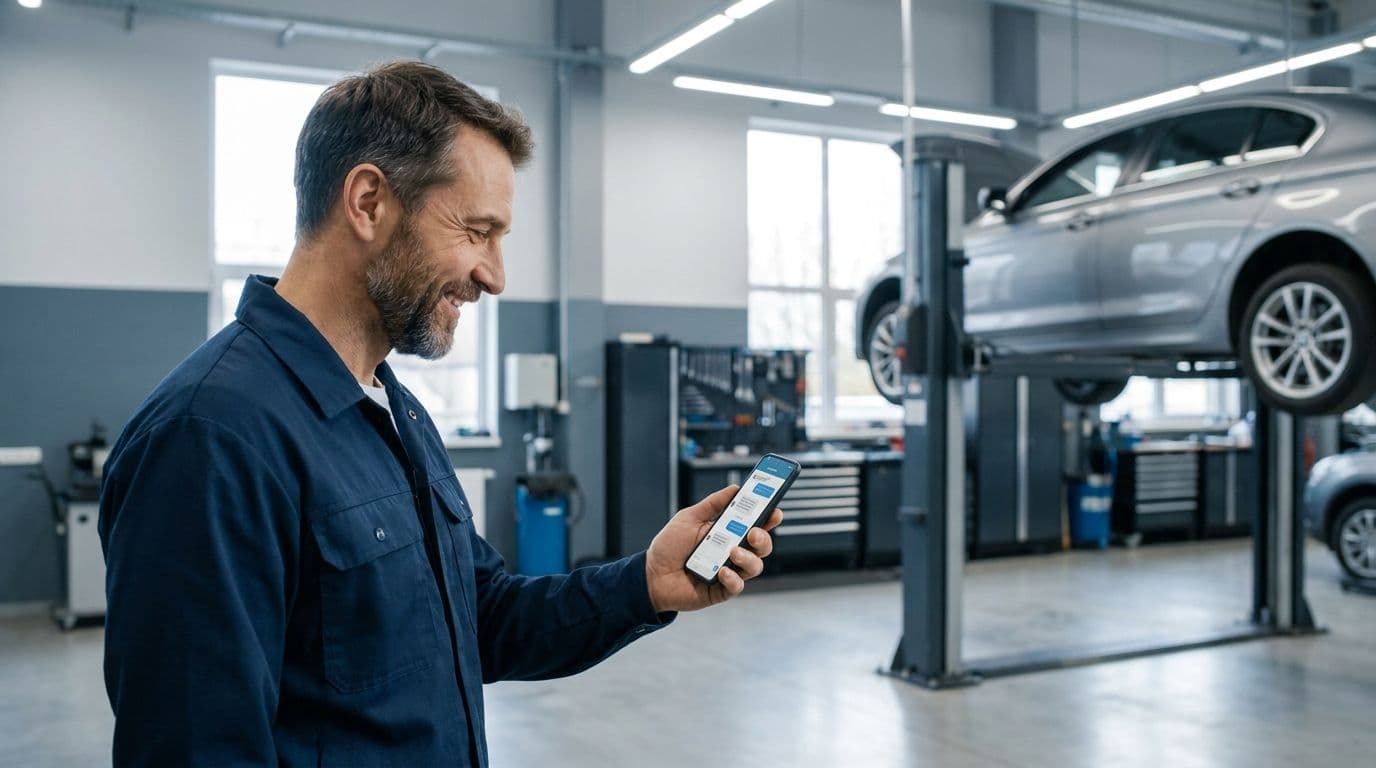
The technician spots an issue. Instead of noting it and hoping to remember it later, they photograph the wear or damage. The image, a clear description of what it is, and a cost estimate go directly to the customer's phone via WhatsApp. There's an Approve or Decline button right in the message.
Shops using this see 15–25% higher repair approval rates. Why? The customer sees the problem with their own eyes. They understand what needs doing and why. The photo kills the distance between "my mechanic says there's something wrong" and "I can see it myself."
4. Service Recall Reminders
Four weeks before an inspection interval expires, or two weeks before the annual service is due, an automated message goes to the customer. Include the recommended service, a simple explanation of why it matters, and a link to book. Triggered by the customer's vehicle data—no manual work.
5. Aftercare Follow-Up
Day after collection: a thank you message and an invitation to leave a review. Simple. Professional. Automatic.
Automation vs Personal Communication
There's a common fear: "Won't automation make us look impersonal?"
No. Automation handles the routine. Personal communication handles the exceptions.
Booking confirmations are automated. Standard milestone updates are automated. Reminders are automated. Aftercare is automated. All triggered by workflow events. All sent when the relevant thing happens, every time.
But when a customer asks a question, a technician explains unexpected findings, or something goes wrong—that's personal. That's a human conversation. The system enables it by removing the noise. Your team isn't fighting to answer routine questions; they're free to have real conversations when they're needed.
The distinction is crucial: you're removing communication work, not adding it.
WhatsApp Business API vs Personal WhatsApp
If your team is using personal WhatsApp to contact customers, stop.
Personal WhatsApp has no shared audit trail. It's tied to one person's phone. There's no automation, no scheduling integration, no GDPR consent management. If that person leaves, those customer relationships leave with them. The standard WhatsApp Business app sounds better, but it still uploads your entire phone contact list to Meta's servers—a privacy liability.
WhatsApp Business API via a certified Business Service Provider (BSP) is different. Messages come from a business number, visible to the entire team. Every message is logged against the customer record. Workflows trigger messages automatically. Consent is tracked and audited. No personal contact list uploads. Data Processing Agreements are in place.
This is also the only way to use WhatsApp professionally within GDPR. Link to your scheduling system and you've got seamless booking confirmation, status updates, and reminders all flowing through the same channel.
GDPR and Customer Communication: The Essentials
Here's the legal foundation you need to get right.
Transactional messages (booking confirmations, status updates, service reminders related to an active job) are part of your contract with the customer. They don't need separate marketing consent—they're essential to the service.
Marketing messages (promotional offers, loyalty campaigns, new service announcements) require explicit opt-in consent. Under GDPR Articles 6 and 7, consent must be freely given, specific to the channel, and timestamped. No pre-ticked boxes. No "consent by continuing to use this site."
Every marketing message must include an easy opt-out. A consent list of 500 customers who genuinely want to hear from you is infinitely more valuable than a list of 2,000 who didn't ask to be contacted. Unsolicited marketing kills reputation and invites complaints.
For the full framework, see the GDPR compliance checklist for independent workshops.
Setting Up Your Garage Communication Strategy
Step 1: Audit Your Current Communication
Spend one week tracking: How many calls come in? How many are answered? How many status enquiry calls arrive? What's the average time between a customer requesting an estimate and approving it? How many service recall reminders do you actually send? How much of your team's time is spent on personal WhatsApp conversations with customers?
Your baseline tells you where the biggest gains are. If you're missing 50% of calls, that's your first target. If estimate approvals take 5 hours on average, that's your bottleneck.
Step 2: Choose Your Communication Stack
Primary channel: WhatsApp Business (via API). Supplement with SMS for customers who don't use WhatsApp, and email for invoices and records.
Here's the critical decision: does your garage management system have native WhatsApp integration, or is it a bolt-on third-party service?
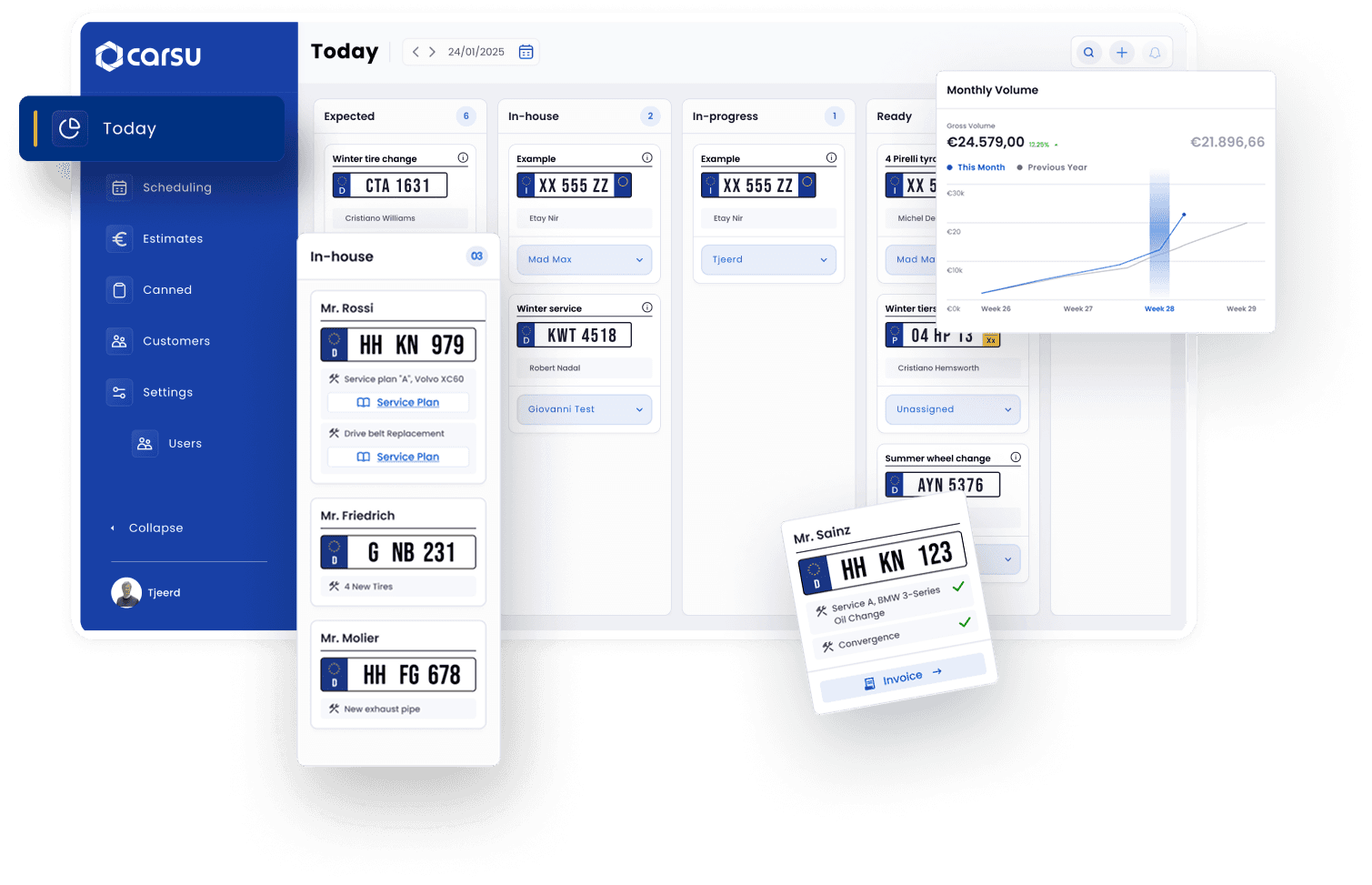
Native integration means messages, approvals, and conversation history live in the same interface as job cards, scheduling, and customer records. You see yesterday's approved estimate right next to today's job card. You don't app-switch. You don't fragment the record.
A bolt-on means a separate app, a separate inbox, separate history. You send an estimate via the third-party app, but the job card is in the garage management system. The information about what the customer approved is siloed from where you're actually managing the work.
This is where Carsu's approach differs: WhatsApp Business integration is native. Same interface, complete history, no switching.
Step 3: Set Up Automated Messages
Start with four automated messages:
- Booking confirmation (when job is scheduled)
- Service started (when vehicle is checked in)
- Vehicle ready (when job is completed)
- Service recall reminder (triggered by maintenance intervals)
These alone eliminate most status enquiry calls. Your team stops being an answering service for "is my car ready?" and starts doing actual work.
Step 4: Implement Digital Vehicle Inspections
Train your technicians to photograph issues. Worn tyres, leaking seals, corroded components—whatever needs approval.
The photo, a description, the cost, and approval buttons go to the customer's WhatsApp. Entire flow in one system. No email back-and-forth. No phone calls asking for clarification.
This is the highest ROI of all communication improvements. 15–25% increase in approval rates translates directly to revenue.
Step 5: Collect GDPR Consent Systematically
Add a consent step to your customer intake form (first visit or when they join your customer management system). Record channel preference (WhatsApp, SMS, email), purpose (service updates, promotional offers), and timestamp.
Audit regularly. Remove customers who opt out. Respect preferences.
Step 6: Add Marketing Campaigns (When Ready)
Once you've got 500+ customers with genuine marketing consent, seasonal campaigns have real impact. "Winter tyre promotions," "loyalty discount on next service," "new electric vehicle servicing available." A single well-timed campaign to 500 opted-in customers can fill a week's bookings.
Communication Software: What to Look For
Not all garage management software handles communication well. When evaluating options, these features matter:
Native WhatsApp Business Integration
Direct API connection. Same interface as job cards, scheduling, and customer records. Handles template approval (WhatsApp Business requires pre-approved message templates), conversation threading, and media attachments. If you're switching between apps, the software isn't solving the problem.
Automated Message Triggers
Workflow-event based. When a vehicle is checked in, the message sends automatically. When work is completed, the next message goes out. If someone has to remember to press a send button, it won't happen consistently—and that defeats the purpose.
Multi-Channel Support
WhatsApp is primary, but SMS and email should be available. Respect customer preference and store it. If a customer prefers SMS for some messages and WhatsApp for others, the system should know.
GDPR Consent Management
Per customer, per channel, per purpose. Prevent marketing messages from going to non-opted-in customers. Exportable consent logs for audits. This is non-negotiable.
Digital Vehicle Inspection with Media
Photo or video capture, direct delivery via WhatsApp, in-message approval buttons. Entire workflow in one system. No separate apps, no uploads, no delays.
Conversation History
Every message logged against the customer record. Full history visible to any team member. This is your audit trail and your institutional memory.
Template Management
WhatsApp Business requires templates for business-initiated conversations. The software should manage template creation, handle Meta’s approval process, and allow dynamic field customisation (customer name, vehicle registration, job details).
Measuring Communication Performance
Track these metrics to understand what’s working:
Response time to customer enquiries: Goal: under 30 minutes during business hours.
Estimate approval rate: Percentage of digital vehicle inspections that result in approved additional work. Compare before and after implementation.
Estimate approval time: How quickly does the customer approve? Goal: under 2 hours from DVI to approval.
Status enquiry calls: Should drop significantly once automated updates are live. Track call volume before and after.
Missed call rate: Fewer calls need answering when routine questions move to messaging.
Reminder conversion rate: Percentage of service recall reminders that result in actual bookings. This is the clearest measure of recovered revenue.
Customer opt-in rate: Percentage of your total customer base with marketing consent. A healthy target is 60–70% within 6 months of systematic consent collection.
Common Mistakes to Avoid
Sending Too Many Messages
Stick to the five key touchpoints. Anything beyond risks annoying customers and triggering opt-outs. More messages doesn’t equal better communication.
Treating Communication as IT
It’s a workflow change, not a technology project. The biggest risk isn’t the software—it’s your team not using it consistently. Invest in training. Build it into standard procedures. Hold people accountable.
Forgetting the Human Element
Automation handles routine brilliantly. But an angry or confused customer needs a human. The system must enable a seamless switch from automated to personal. Professional doesn’t mean robotic.
The Business Case: What Communication Improvement Is Worth
For a typical 5-person garage handling 20–25 vehicles per day:
Recovered revenue from service reminders: 3–5 extra bookings per week from a customer base of 2,000. Average job value: €230. Annual impact: €34,000–€57,000.
Increased repair approvals from digital vehicle inspections: 15–25% improvement on additional work recommendations. 15 additional recommendations per week × 20% improvement = 3 extra approved jobs per week. Average value: €170. Annual impact: €26,000.
Reduced admin time from status updates: 30–45 minutes per day saved by eliminating “is my car ready?” calls. 150–200 hours per year. At €30 per hour loaded cost: €4,500–€6,000.
Recovered revenue from missed calls: Even a conservative 10% recovery on those currently unanswered calls. Annual impact: €6,000–€18,000.
Conservative total annual impact: €72,000–€108,000 against software costs of €1,500–€3,000 per year.
ROI is measured in weeks, not months.
Conclusion: Communication Is the Competitive Advantage You’re Underestimating
You can’t easily differentiate on quality—your work is as good as your competitors’. You can’t always compete on price. But experience? That’s yours to own.
Experience is communication. It’s knowing what’s happening with your car without calling. It’s approving work in 90 seconds instead of 5 hours. It’s getting reminded about your service before you’ve forgotten it’s due.
The tools exist. The channels are ready. Your customers already prefer messaging.
Carsu brings native WhatsApp Business integration, automated reminders, digital vehicle inspections, and GDPR-compliant consent management directly into the garage management system. No bolt-ons. No separate apps. No manual work. Everything you need to transform customer communication is built in from the start.
Start your free trial today and see how much time and revenue you recover in the first week.
Clear customer messaging is only half the equation. The other half — pricing the job accurately, getting approval, tracking progress, and delivering on budget — is where workshops either protect or leak margin. For a complete playbook, see our guide to workshop estimates and job management.